
Active Travel Strategy 2 (ATS2)
Work is taking place to develop a new Active Travel Strategy (ATS2) for East Dunbartonshire.
ATS2 is a 10-year plan (2027-2037) to help make walking, wheeling or cycling the first and natural choice for local everyday trips.
Consultation on the draft ATS2 is taking place between 5 October and 15 November 2026. Please visit the consultation webpage for more information.
If you have 10 minutes, please fill in our online survey below.
Survey
In addition, drop-in sessions are being held:
- Mugdock Country Park (meeting room in Courtyard) – Thursday 15 October 2026, between noon and 4pm
- Kirkintilloch Leisure Centre – Thursday 22 October 2026, between 3pm and 7pm
- Lennoxtown Library – Tuesday 27 October 2026, between noon and 4pm
- Bishopbriggs Library – Thursday 29 October 2026, between 2pm and 6pm
- Milngavie Library – Wednesday 4 November 2026, between 1pm and 5pm
- Bearsden Community Hub (Lesser Hall) – Monday 9 November 2026, between 3pm and 7pm.
The draft ATS2 is available to read/download, as well as the associated Delivery Plans, Evidence Reports (including Evidence Summary Report), SEA Environmental Report and draft ATS2 Policies.
You can also view the ATS2 interactive map.
Introduction
The Council has a target for the East Dunbartonshire area to reach net zero emissions by 2045.
Creating the conditions to support additional active travel is a core part of achieving this target, particularly since transport is the highest emitting sector in Scotland.
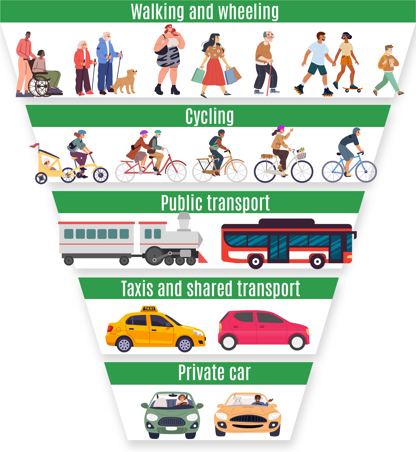 Active travel is sometimes viewed simply as cycling, but its definition is wider and includes ‘walking and wheeling’ – getting around while using wheelchairs, mobility scooters, walking frames, pushing prams/buggies and more.
The draft ATS2 sets out the policies and actions required to drive forward ‘modal shift’ – moving from one form of transport to another – and how to best apply the National Transport Strategy’s Sustainable Travel Hierarchy (see pic).
ATS2 will also help to deliver the Council's transport needs and wider policy objectives relating to:
- Climate and Environment
- Health and Wellbeing
- Equality and Inclusion
- Inclusive Growth and Local Economy.
Engagement to date suggests public support for proposed measures set out within this ATS2.
Extensive input and evidence was gathered through the 2021 Active Travel Discussion and re-affirmed through more recent engagement, which informed the four key themes for active travel policy and actions:
- Walking and Wheeling Network – high-quality, accessible walking and wheeling routes that connect key trip generators in towns and villages
- Connectivity Corridors – safe on-road cycling infrastructure or development of People-First streets along main routes that connect places people want to go
- Behaviour Change – initiatives that give people of all ages and abilities the confidence and capabilities to switch their local everyday journeys to active travel
- Green Active Travel Networks – a series of interconnected routes linking towns and villages to the countryside and quality recreational open space.
Benefits of Active Travel
Participating in active travel can have a wide range of benefits for individuals, local communities and the environment, including:
- Improved health and wellbeing through increased levels of activity
- Improved access to local amenities and jobs
- Economic development and growth (including town centres and tourism)
- Reduced congestion
- Improved air quality
- Better, safer and more pleasant streets and places for people
- Environmental benefits.
Barriers to Active Travel
There are a number of barriers to active travel uptake, including:
- Safety and security
- Convenience
- Carrying things and transporting people
- Vehicle-dominated environments
- Access, such as cycle ownership, maintenance and storage, and social and physical barriers
- Conditions, such as distances, hills and weather.
ATS2 aims to address and overcome these barriers, creating a more accessible and attractive active travel network for all.
Mission
The mission of ATS2 is that…
“Walking, wheeling or cycling will be the first and natural choice for local everyday trips”
Creating the conditions to support enhanced active travel will play a vital role in improving environmental, health and wellbeing outcomes for residents, as well as those working, studying in and visiting East Dunbartonshire.
Priorities
In addition to the mission, eight priorities have been developed to help deliver the widest possible benefits for individuals and communities in East Dunbartonshire.
The priorities of ATS2 will closely align with the Transport Planning Objectives (TPOs) of the Local Transport Strategy (LTS).
The eight priorities proposed in ATS2 are:
Increasing modal shift
1.Provide safe and easy access to everyday places
2. Improve integration between active travel and public transport.
Reducing inequalities
3. Empower and encourage all groups of people to walk, wheel and cycle more.
Reducing emissions
4. Improve active travel opportunities to and through areas where air quality issues may pose risks to the public and, in particular, children (for example schools and town centres).
Facilitating sustainable economic growth
5. Make East Dunbartonshire an attractive place for active travel to generate more sustainable business for the local economy.
Improving health
6. Improve physical health, mental health and overall wellbeing by providing better opportunities for walking, wheeling and cycling for travel to work/school, and for leisure and exercise purposes – including enhanced access to areas of green space.
Improving safety
7. Ensure vulnerable road users, including those walking, wheeling and cycling, are safe on East Dunbartonshire’s road network
8. Ensure surfaces are of a high standard so appropriate paths and routes can be safely accessed and enjoyed by all.
If you have any questions, please email sustainability@eastdunbarton.gov.uk
If you have feedback on the draft Active Travel Strategy, please visit the consultation webpage and complete the online survey.
Evidence Reports
-
Evidence Report A - Policy And Key Statistics
-
Evidence Report B - Network Audit
-
Evidence Report C - Network Connectivity Assessment
-
Evidence Report D - Delivering Active Travel Projects And Policy
-
Evidence Report E - Resident Survey Findings
-
Evidence Report F - Active Travel Discussion
-
Evidence Report G - Options Generated
-
Evidence Report H - Appendices 1-6
Frequently Asked Questions (FAQs)
Active travel means getting around by walking, wheeling or cycling. This includes wheeled mobility aids and different kinds of cycles.
Each proposed ATS2 priority is linked to a Transport Planning Objective within the Local Transport Strategy. Eight priorities for active travel are proposed in the draft ATS2, which influenced the policies and actions to deliver the widest possible benefits for individuals and communities in East Dunbartonshire.
No decisions on the type of infrastructure or how it will look have been made at this stage. Proposed interventions and exact alignments will be determined through feasibility assessment and will be subject to the availability of funding.
The timescales for the delivery of interventions are indicative and have not been firmly set at this stage. Many of the interventions will require external funding to take forward design and public engagement studies. As such, they will be dependent on successful funding bids and be subject to timescales agreed with external funders.
National and local transport policies support a significant improvement to conditions for people walking, wheeling or cycling, and a reduction in car use for shorter journeys. This will allow more people to make different choices about how they travel locally. Achieving this will help reduce the deterioration of the local road network caused by daily traffic use.
It is expected that the delivery of most or all the interventions will leverage external funding which is ringfenced for active travel improvements and cannot be used for routine road maintenance. The Council’s road maintenance budget would not be used towards delivering any of the active travel interventions covered by ATS2.
The timescales for the delivery of interventions on the routes shown in the Walking and Wheeling Network Delivery Plan and the Connectivity Corridors Delivery Plan have not been set at this stage. Priority 1 routes are expected to provide the highest level of improvement for the highest numbers of users.
However, some of these routes will require careful consideration to ensure the final designs meet the needs of the local community. Therefore, it is possible that some lower priority routes will be delivered in advance of Priority 1 routes being completed.
Providing safe alternatives to the car has been shown to reduce car use and, by extension, congestion. Detailed feasibility and design studies for each intervention will consider the impacts of any changes to the road layout on traffic congestion and journey times.
This information will be presented as part of the public consultation for any major active travel schemes, as and when these are identified for further feasibility study, to help people understand the effects any proposed interventions would have.
Yes. Any large-scale active travel infrastructure interventions require a detailed design project to be completed prior to delivery. Each design project will include public consultation activities where proposals will be presented for comment.
The consultation feedback will be a key consideration in the design process.
Progress on delivering the policies and actions set out in ATS2 is subject to availability of resources and funding. Reflecting the significant financial challenges that local authorities are facing, ATS2 sets out ambitious actions to ensure that East Dunbartonshire is investment-ready and in as strong a position as possible to attract external funding for delivery.
The Council will keep abreast of new funding opportunities and changes to funding streams throughout the period of this ATS2.
Factors which may delay or constrain the delivery of projects include, for example, land ownership and ground conditions.
Staff capacity, funding availability and the number of projects being progressed at the same time can also affect the timescales for delivery.
Yes, evidencing outcomes is important. Monitoring indicators will be used to measure progress in delivering ATS2 policies and actions, and assess how successfully they support local, regional and national aims.
Annual progress reports will be produced, noting the overall impact on outcomes and objectives, including modal shift, climate change and broader Council objectives.
The Active Travel Strategy 2015-2020 is available as a PDF on request.
To request an electronic copy, please email sustainability@eastdunbarton.gov.uk