
Education Business Improvement Plan 2026-2029
This Business Improvement Plan (BIP) sets out the main actions that the Education Service intends to carry out over the three-year rolling period, 2026-29.
These actions will deliver core priorities and the related objectives of the Local Outcome Improvement Plan (LOIP) and the Strategic Planning & Performance Framework.
The purpose of the Education Service is to deliver excellence, equity and inclusion for all children, young people, families and communities. The shared vision is that all children and young people have the same opportunities to succeed in educational outcomes, wider achievements, positive leaver destinations and life chances.
The Education Service strives to improve attainment and achievement for all learners, with a particular focus on reducing inequalities and narrowing the poverty-related attainment gap.
The Education Service provides high quality provision across:
- 21 Early Years Centres and 1 ASN specialist Early Years provision
- 32 Primary Schools
- 8 Secondary Schools
- 1 ASN School
- 3 Primary Enhanced Learning Resources (ELR)
- 3 Secondary Enhanced Learning Resources (ELR)
- Primary and Secondary Well-being Support Services
- 31 Early Years providers in the private, voluntary, and independent sector, including Childminders who are in contract with the Council to deliver funded Early Learning and Childcare hours
- Post school Employability Support, Youth Work and Adult Learning.
The Education Service has responsibility for delivering and/or contributing to three of the six Local Outcomes.
Specific links between the teams’ activities and delivery of the wider Strategic Group Priorities and LOIP outcomes and guiding principles are as follows:
- Education has a lead role in Local Outcome 3: Our children and young people are safe, healthy and ready to learn
- The Service contributes to Local Outcome 2: Our people are equipped with knowledge and skills for learning, life and work; and
- Local Outcome 4: East Dunbartonshire is a safe place to work, live and visit.
The Education Service supports children, young people and families through highly effective partnership working. The Delivering for Children and Young People’s Partnership (DCYPP) is the multi-agency strategic planning group responsible for progressing actions to achieve Local Outcome 3 priorities. Key partners include the Education Service, Health and Social Care Partnership, Voluntary Action, Police Scotland, Scottish Children’s Reporter Administration (SCRA) and Scottish Fire and Rescue Service.
Other partners include Skills Development Scotland, Education Scotland and Glasgow City Regional Improvement Collaborative (West Partnership).
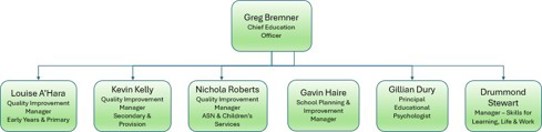
The Chief Education Officer is responsible for the strategic leadership of the Education Service and for advising the local authority on functions as set out in the Education (Scotland) Act 2016. The Chief Education Officer has direct line management responsibility for the Education Leadership Team (ELT) and all Head Teachers.
The Education Leadership Team (ELT) have strategic remits to support planning, improvement and performance across the Education Service. ELT membership includes:
- Chief Education Officer
- Quality Improvement Manager (QIM) Early Years & Primary
- Quality Improvement Manager (QIM) Secondary & Provision
- Quality Improvement Manager (QIM) ASN &Children’s Services
- School Planning and Improvement Manager
- Principal Educational Psychologist
- Skills for Life, Learning and Work Manager.
Quality Improvement Officers (QIOs) support quality improvement and the implementation of actions in the Business Improvement Plan.
Link QIOs are allocated to schools and centres in Learning Partnership Groups (LPGs), to provide support and challenge, focusing on improving attainment and outcomes for children and young people. They support quality assurance, self-evaluation for continuous improvement, career-long professional learning and policy development across the Education Service.
QIOs lead and participate in Quality Improvement Reviews and support schools and centres to continue to build on their strengths and work on areas of focus for improvement. They support link schools and centres to prepare for inspection.
QIOs have individual remits to action sector specific priorities and tasks. They also collaborate to develop cross-sector approaches to Service priorities.
Early Years and Primary Team
- Ensure compliance with legislation, statutory requirements, national and local policy
- Support and challenge schools and centres to improve attainment and outcomes for all children and young people, with a particular focus on reducing inequalities and narrowing the poverty-related attainment gap
- Implement 1140 hours of funded Early Learning and Childcare (Council centres and partnership providers)
- Support centres and schools to implement Curriculum for Excellence, including learning, teaching and assessment
- Support schools and centres to participate in self-evaluation for continuous improvement, including quality assurance activities
- Lead on aspects of policy development and implementation
- Design and deliver Career-Long Professional Learning across all sectors (3-18) in Literacy and Numeracy
- Co-ordinate work in the Scottish Attainment Challenge across all sectors
- Lead on corporate planning and performance across the Education Service.
Secondary and Provision Team
- Ensure compliance with legislation, statutory requirements, national and local policy
- Support and challenge schools to improve attainment and outcomes for all young people, with a particular focus on reducing inequalities and narrowing the poverty-related attainment gap
- Support schools to participate in self-evaluation for continuous improvement, including quality assurance activities
- Lead on aspects of policy development and implementation
- Deliver Instrumental Mustic Programme
- Deliver Outdoor Education and Awards and the Vocational programme
- Support learning pathways for young people, based on robust evidence of the labour market and annual participation measures to ensure sustained positive leaver destinations
- Co-ordinate Local Negotiating Committee for Teachers (LNCT).
Additional Support Needs and Children’s Services Team
- Ensure compliance with legislation, statutory requirements, national and local policy
- Support and challenge schools and centres to ensure that all children and young people enjoy their rights, equality and equity, ensuring inclusion and presumption of mainstream are key
- Lead and deliver targeted interventions and support packages through the Locality Liaison Group (LLG) and GIRFEC Liaison Group (GLG) allocation panels
- Support Tier 2 provisions (Enhanced Learning Resources, the Primary Wellbeing Support Service and the Secondary Wellbeing Support Service) and Tier 3 provision (Woodland View School)
- Co-ordinate a range of specialist support services: Sensory Impairment; Language and Communication; Wellbeing Support and the Assistive Technology Teacher
- Lead on corporate planning and performance across the Education Service with regards to additional support needs
- Taking a lead role in developing and implementing key policies: Child Protection and Safeguarding; Getting it Right for Every Child (GIRFEC) framework; Including Every Learner (IEL) policy frameworks; Sensory policy; Children’s Rights – United Nations Convention on the Rights of the Child (UNCRC); Managing the Healthcare Needs of Children; The Promise; Accessibility; Equalities & Diversity; Inclusion; Exclusions; Child Poverty; CIRCLE; and the Relationships, Behaviour and Learning policy framework
- Design and deliver Career-Long Professional Learning across all sectors (3-18) in Health & Wellbeing, additional support needs and the ASN Leadership Forum
- Lead, coordinate and develop provision under the Whole Family Wellbeing Fund.
School Planning and Improvement Team
- Workforce planning: probationer placements; recruitment of permanent supply teachers; staffing provision in all schools (including supply staff); and classification structures in primary schools
- Information systems and data: Annual Census data; attainment data; SEEMiS Education Management Information System; Groupcall; and the Parent’s Portal
- Partnership working with the Education Shared Services Team supports school admissions, placing requests and transport
- Service planning is supported through the work of the team in roll projections, accommodation schedules and updating Procedure Manuals
- Strategic link with Major Assets and Facilities to support ongoing work across the Education Estates. This includes remedial work across the existing estate and major capital projects, including new builds.
Educational Psychology Service (EPS)
- Implement statutory duties to support the Council in addressing national and local priorities for education through the application of psychological knowledge and skills
- The Service has 5 core functions of consultation, assessment, intervention, training and research. These are evidenced across the 3 levels of children and families, educational establishments and authority/national
- Lead role in the following areas: Nurture Intervention (primary, secondary and early years); Promoting Attendance (guidance and implementation); Supporting Inclusion using the CIRCLE approach and Up, Up and Away for Early Years; Supporting Mental Health and Wellbeing (multiagency suicide and self-harm guidance, mental health training),Transforming
- Connections Trauma training; Learning through Play and Enquiry Based Learning; Supporting families and schools through Non Violent Resistance (NVR); Authority de-escalation professional learning (CALM); and Supporting Literacy and Numeracy Difference (dyslexia and dyscalculia).
Skills for Learning, Life and Work Team
- Contribute to the Council’s Workforce Strategy, including early careers development to improve the employability skills of young people through apprenticeships, graduate programmes and other work experience opportunities
- Lead on the Council’s Community Learning and Development Plan in the areas of adult learning and youth work
- Lead on the Local Employability Partnership and co-ordinate the Scottish Government’s No One Left Behind and Parental Employment Support strategies, plans and programmes. This includes ensuring all age employability provision meets the needs of those who have barriers to employment
- Adult learning: Vocational skills and training; literacy skills and English for Speaker of Other Languages; and Numeracy skills support to parents and other adults is a continued focus and is supported by Shared Prosperity Multiply Funding
- Deliver National Youth Work outcomes for young people requiring additional support
- Implement Positive Achievements projects to provide a range of support for senior phase pupils who have barriers to attending school
- Support the work of the Youth Council and Members of the Scottish Youth Parliament.
Our Priorities for 2026-29
Excellence and Equity
Excellence is achieved through raising attainment and improving outcomes, ensuring that every child and young person achieves the highest standards in literacy and numeracy; as well as the values, attitudes, knowledge and skills to shape a sustainable future as successful learners, confident individuals, responsible citizens and effective contributors. Equity is achieved by ensuring that every child and young person has the same opportunity to succeed, no matter their background or shared protected characteristics, with a particular focus on narrowing the poverty-related attainment gap.
Strategic priorities will ensure that every child and young person experiences great teaching, resources and support for high quality learning that builds their confidence and equips them to be successful and to contribute to their life, work, and world, so they know how much they matter. The rights of every child will be respected, protected and fulfilled to ensure these are incorporated fully across the education system.
National Improvement Framework and Improvement Plan (NIF)
Strategic priorities for the Education Service are underpinned by National Policy: Achieving Excellence and Equity: National Improvement Framework and Improvement Plan (NIF).
The NIF sets out the vision and priorities for Scottish education that have been agreed across the system, and the national improvement activity that needs to be undertaken to deliver those key priorities.
The National Improvement Framework (NIF) states that Scottish education should be ambitious, inclusive, and supportive in order to deliver:
- Excellence through raising achievement and improving outcomes: ensuring that every child and young person achieves the highest standards they can
- Achieving equity: ensuring every child and young person has the same opportunity to succeed
Key priorities of the National Improvement Framework
The key priorities of the National Improvement Framework are as follows:
- Placing the human rights and needs of every child and young person at the centre of education
- Improvement in children and young people’s health and wellbeing
- Closing the attainment gap between the most and least disadvantaged children and young people
- Improvement in skills and sustained, positive school-leaver destinations for all young people
- Improvement in achievement, particularly in literacy and numeracy.
The outcomes that are expected to be achieved are as follows:
- A globally respected, empowered, and responsive education system with clear accountability at every level that supports children, young people, and adult learners to thrive. The system enables the development of their knowledge, skills, values, and attributes that give them the best opportunity to succeed and contribute to Scotland’s society and economy
- Young people experiencing the benefit of schools and early years settings working in excellent partnerships with wider children’s services and other partners, families, and communities, in line with the GIRFEC approach
- Inclusive and relevant curriculum and assessment which gives young people the knowledge and skills necessary to contribute to society, and shape a sustainable future, while celebrating and supporting progression for all
- High levels of achievement across the curriculum for all learners, with action to close the poverty-related attainment gap
- Highly skilled teachers and school-leaders driving excellent learning, teaching and assessment for all, especially those with additional support needs
- Improving relationships and behaviour, and attendance, with increased engagement in learning in a culture of dignity and respect for all
- An education system engaging in digital technologies to enhance all aspects of learning and teaching, supported by a digitally skilled workforce and tackling digital inequality.
The new Vision for the Education Service ‘Excellence for All - A commitment to excellence, equity and inclusion that empowers all children and young people to succeed in learning and life’ combined with the carefully chosen values of respect, courage, creativity, fairness and trust encapsulate the skills, actions and values expected for all our staff, children and young people.
In line with the Education Service vision of ‘Excellence for All’, the totality of these performance indicators is at the core of all carefully considered priorities to ensure continual improvement across Education Service. Priorities are fully outlined in the Business Improvement Plan (BIP) and Education Service Plan (ESP).
Strategic priorities are underpinned by legislative requirements in the Education (Scotland) Act 2016, the NIF and Council policy and planning, principally the LOIP and the Integrated Children’s Services Plan.
How we contribute to our agreed Local Priorities
Employment and Skills
- Skills development of children and young people through Developing the Young Workforce (DYW) in the curriculum
- Contribute to the Council’s Workforce Strategy, including early careers development to improve the employability skills of young people through apprenticeships, graduate programmes and other work experience opportunities
- Adult learning: Vocational skills and training in Literacy and Numeracy
- Career-Long professional learning programme to improve employability and skills of the Education Service workforce
- Post school employability support.
Delivering for Children and Young People
- The Education Service works with multiagency partners to deliver statutory duties in Child Protection and Safeguarding
- The Service contributes to Local Outcome 2: Our people are equipped with knowledge and skills for learning, life and work; and Local Outcome 4: East Dunbartonshire is a safe place to work, live and visit
- Education has a lead role in Local Outcome 3: Our children and young people are safe, healthy and ready to learn
- The delivery of youth work aligned to schools.
Safer and Stronger Communities
Traffic Free Schools Initiative in partnership with multi-agencies.
Climate Change Mitigation
- Traffic Free Schools Initiative in partnership with multi-agencies
- Learning for Sustainability across the curriculum
- Keep Scotland Beautiful Programmes, including Eco-Schools.
Cost of Living Support
- Implementing actions to mitigate against poverty, including Cost of the School Day
- Supporting families to access Free School Meals and School Clothing Grants
- Signposting families to advice and support.
Key Improvement Actions
The Education Service has a lead role in Local Outcome 3: Our children and young people are safe, healthy and ready to learn.
To meet the Education Service Strategic Priorities and drive forward continuous improvement, the Education Leadership Team continues to lead the direction of the new improvement strategy (IMAGINE). Building on existing strengths, this new improvement strategy is providing a structured framework to streamline approaches, ensuring ongoing developments within education and outcomes from continuous self-evaluation are effectively integrated into establishments across the authority.
The comprehensive strategy continues to span Early Years and Childcare (EYC), Primary and Secondary Education, including Skills for Learning, Life and Work. It is supported by seven key strategic groups: leadership, learning and teaching, tracking and monitoring, curriculum, partnerships, well-being and inclusion and skills for life, learning and work.
- Priority 1. Leadership
- Priority 2. Leadership and Teaching
- Priority 3. Tracking and Monitoring
- Priority 4. Curriculum Priority
- Priority 5. Partnerships Priority
- Priority 6. Welbeing and Inclusion Priority
- Priority 7. Skills for Learning, Life and Work.
The strategy is grounded in the importance of leadership at all levels, driving positive change and transformation. Education Services is committed to the overall success of the strategy, focussing on developing and empowering the leadership of staff at all levels, enabling them to drive forward continuous improvement across all establishments.
The Education Service believes that by working together as a close team, they can collectively lead more effectively, ensuring all our children and young people meet their full potential in education and beyond. For this reason, all schools are represented in the IMAGINE leadership strategy.
To quote from the Education Scotland’s Thematic Review of the Education Service in September 2024:
The culture of high levels of trust, high aspirations and high expectations permeates all levels of the system. The relationship-based approach leads to highly effective collaboration at all levels with a strong focus on improving experiences for children and young people.
IMAGINE continues to develop and refine our systems, continuing to emphasise excellence and equity while also focussing on addressing the Poverty Related Attainment Gap (PRAG).
The Strategic Groups are overseen by an identified Quality Improvement Manager and led by an identified Headteacher.
Membership of the Strategic Groups include Quality Improvement Officers, Central Officers and a member of the Senior Leadership Team from all schools and standalone Early Years Centres (EYCs).
These priorities are detailed within the Education Service Plan 2025 – 2028 where actions are clear with outcomes, measures and timescales. Progress within these seven priorities will be reported monthly, biannually and annually in line with How Good is our Service Performance Policy and Guidance.
Strategic Priorities (NIF)
To read the Education Services 5 Strategic Priorities (NIF), view our Education Service Business & Improvement Plan tables document.
Priority Performance Indicators
To read our priority performance indicators, view our Education Service Business & Improvement Plan tables document.
Sustainability
We recognise that we have a role to play in responding to the global climate and ecological emergency, and improving well-being and we will do so via the activities described in the Sustainability section of the Education Business & Improvement Plan tables document.
Consultation and Engagement
To read the Consultation and Engagement Action Plan for all services, visit the Consultation and Engagement Action Plan 2026/27.