
Ash Dieback in East Dunbartonshire
Ash Dieback, sometimes referred to as Chalara, is a disease affecting Ash trees and caused by a fungus (Hymenoscyphus fraxineus). It was first detected in the UK in 2012.
Ash trees across Scotland are now showing clear signs of Ash Dieback, and it is expected that a high proportion of them will subsequently die from, or be significantly affected by, the disease in the next two decades. Currently there is no known efficient prevention or curative treatment.
Ash Dieback kills a tree from the top down. The foliage and branches will blacken, and the disease will spread downwards through the tree, eventually working its way to the roots.
Why is Ash Dieback an issue?
The level of loss caused by Ash Dieback will have serious impacts on biodiversity. It also poses potential issues for properties and roads near infected trees which are liable to breakage.
It is essential that the Council and all landowners and private property owners, assess any Ash on their land to identify the extent of Ash Dieback and then take appropriate action.
At present, if East Dunbartonshire Council receives an enquiry or a notification that a tree may have this disease, the Council’s arborist inspects and manages reports on an individual basis. This may involve the complete removal of an infected tree or remedial pruning works. Priority is given to trees within falling distance of roads, paths or adjoining properties.
Through its rolling programme of open space woodland and tree surveys, the Council is carrying out an evaluation of the current level of disease within the area to identify, evaluate and prioritise action with reference to the guidance issued within the Publication “Ash Dieback: an Action Plan Toolkit for Scotland”. By doing so, this enables the Council to proceed with a formal monitoring and tree survey/felling and re-planting programme, that will help fulfil its duty of care of assets and public risk.
As part of East Dunbartonshire Council’s tree management programme, the Council commissions independent tree surveys along transportation corridors, schools and open spaces, with the results digitally recorded and drawn on GIS maps.
The full extent of the level of Ash Dieback is unknown, particularly as a substantial level of land within East Dunbartonshire is privately owned. The Council’s first roadside ash dieback survey was programmed for Summer 2023, covering circa 523 kilometres of A, B, C and U roads.
The data gathered through open space and roadside survey will aid the Council in the production of an Ash Dieback Roadside Action report with associated recommendations - prioritised by level of risk, and an assessment of budget implications and identification of
areas requiring immediate action and also areas for replanting with native species.
Landowners with dangerous trees or limbs impacting on the road network will be notified through the Council’s Roads team to raise awareness and request that appropriate works are carried out with 28 days. Failure to respond to repeated requests may result in the Council undertaking the works and reclaiming costs.
How does Ash Dieback affect a tree?
Growing trees are known to be weakened to the point where they succumb to secondary pests or pathogens, e.g. Armillaria fungi (honey fungus), particularly where basal lesions are present.
Timescales on speed of decline vary; mortality has been observed in as little as two growing seasons. As an Ash tree declines, and where it is affected by secondary pathogens, it appears to more rapidly lose timber strength and integrity and is prone to structural failure, making the management and felling of infected trees hazardous, and costly.
Some Ash trees appear to be more able to tolerate infection. Therefore, the use of crown reduction or pollarding instead of felling, natural regeneration of felled trees, and propagation of tolerant trees may help build future resilience to this disease. Tree health scientists are studying the genetic factors which convey tolerance so that such trees can be used for breeding tolerant ash trees for future recovery actions.
What influences the extent of the disease?
The climate, site conditions and local tree cover appear to play a large role in the extent to which trees are affected by the disease.
Local fragmentation of tree cover has been found to be an important factor with isolated trees, trees growing in open areas or trees in hedges far less affected than those in a forest environment.
It has been shown that these trees will be subjected to a different microclimate with higher canopy temperatures, which are unfavourable to development of the disease. Host density has also been found to be important for disease development, with Ash at a low density far less affected by Ash Dieback.
What are the visual signs of Ash Dieback?
Symptoms, especially crown dieback and loss of foliage, are relatively easy to spot. Look out for the following visual signs of Ash Dieback.
- Dark patches appearing on leaves during summer months. These leaves will eventually wilt and/or discolour and may shed early
- Diamond-shaped lesions appear and are often darker brown in colour
- Around where the branch meets the trunk, a grey colour appears under the bark
- Once dormant buds around the trunk begin to sprout as the tree attempts to survive. This is a common sign of a stressed tree.
The classification of this disease’s progression is as follows [1]:
- Ash Health Class 1 – 100-75% Canopy remaining
- Ash Health Class 2 – 75-50% Canopy remaining
- Ash Health Class 3 – 50-25% Canopy remaining
- Ash Health Class 4 – 25-0% Canopy remaining.
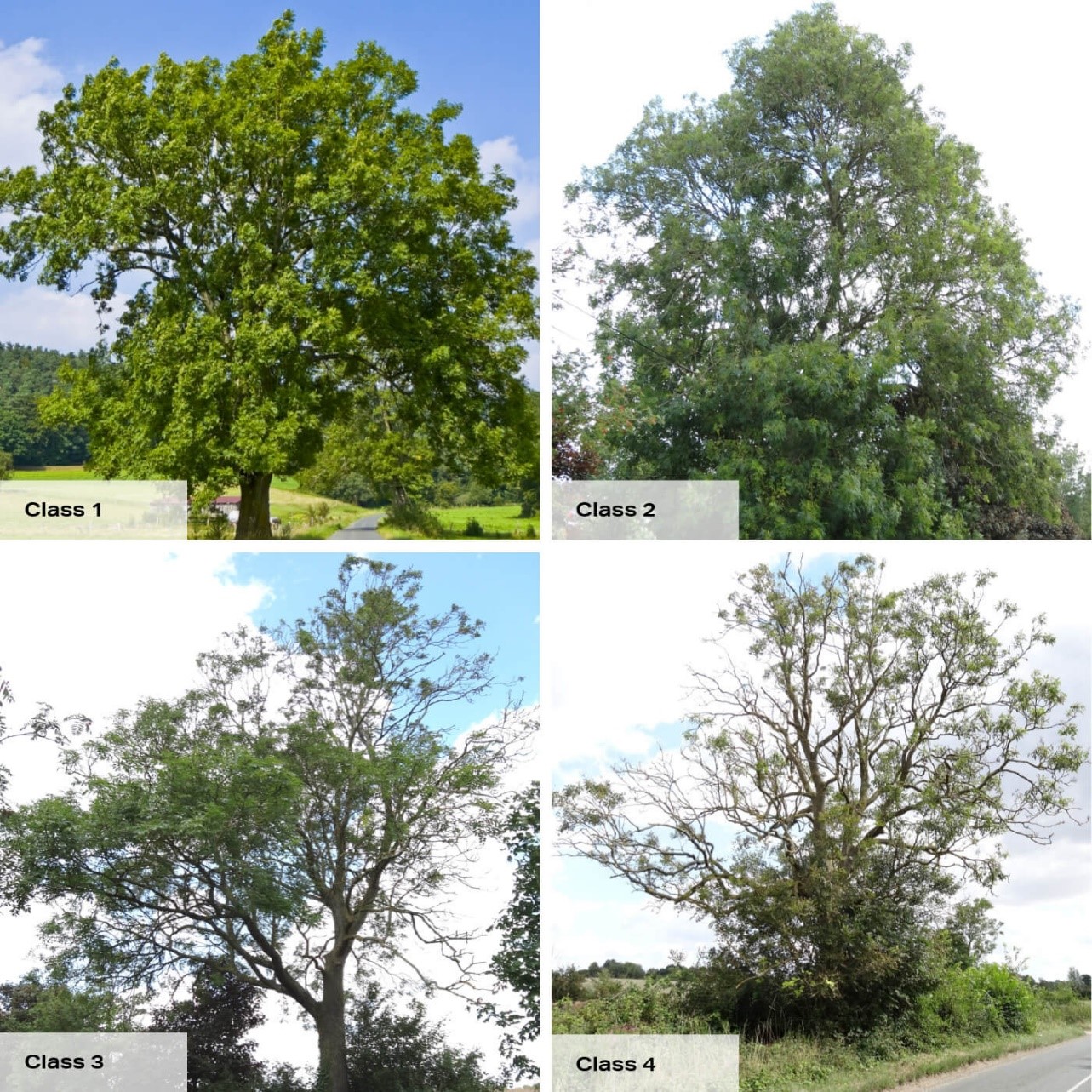
Click the image above to enlarge
The importance of Ash in the UK
The common Ash (Fraxinus excelsior) is one of our most important and prolific native tree species.
The species accounts for 12% of broadleaved woodland in Great Britain and is commonly found in parks, gardens and hedgerows.
They grow in a wide range of soils and climatic conditions, fulfilling roles in terms of amenity and ecosystem services, whilst providing valuable habitat for a wide range of species.
There are 955 species associated with Ash trees, of which 45 are believed to have only ever been found on Ash.
More information
You can find more information by visiting the website of Scotland’s Tree Council’s website.