
Complaints Handling Toolkit
Introduction
Our Complaints Handling Procedure (CHP) reflects the Council’s commitment to resolving customer dissatisfaction as close as possible to the point of service delivery.
We have produced a standard approach to handling complaints which complies with the Scottish Public Sector Ombudsman’s (SPSO) guidance on complaints handling. Read the Guidance on a Model Complaints Handling Procedure.
Complaints can give us valuable information we can use to improve service provision and customer satisfaction. Our CHP will enable us to address a customer's dissatisfaction and may help us prevent the same problem from happening again.
This toolkit is designed to help those of us who may have to respond to a complaint in our service area to deal with the complaint effectively.
Frequently Asked Questions (FAQs)
We regard a complaint as any expression of dissatisfaction about our action or lack of action, or about the standard of service provided by us or on our behalf. A complaint may relate to the following, but is not restricted to this list:
- Failure or refusal to provide a service
- Inadequate quality or standard of service, or an unreasonable delay in providing a service
Dissatisfaction with one of our policies or its impact on the individual - Failure to properly apply law, procedure or guidance when delivering services
- Failure to follow the appropriate administrative process
- Conduct, treatment by or attitude of a member of staff or contractor (except where there are arrangements in place for the contractor to handle the complaint themselves)
- Disagreement with a decision, (except where there is a statutory procedure for challenging that decision, or an established appeals process followed throughout the sector).
There are some things that can’t be dealt with through our complaints handling procedure. These include:
- A routine first-time request for a service
- A first-time report of a fault (for example, potholes or street lighting)
- A request for compensation only
- Issues that are in court or have already been heard by a court or a tribunal
- Disagreement with a decision where there is a statutory procedure for challenging that decision (such as for freedom of information and subject access requests), or an established appeals process followed throughout the sector – such as council tax, planning, parking ticket or placing request appeal
- Disagreement with decisions or conditions that are based upon social work recommendations, but determined by a court or other statutory body, for example decisions made by a children's panel, parole board or mental health tribunal
- A request for information under the Data Protection or Freedom of Information (Scotland) Acts
- A grievance by an employee or a grievance relating to employment or employee recruitment
- A concern raised internally by an employee (which was not about a service they received, such as a whistleblowing concern)
- A concern about a child or an adult’s safety
- An attempt to reopen a previously concluded complaint or to have a complaint reconsidered where we have already given our final decision
- Abuse or unsubstantiated allegations about our organisation or employees where such actions would be covered by our Unacceptable Customer Behaviour Policy; or
- A concern about the actions or service of a different organisation, where we have no involvement in the issue (except where the other organisation is delivering services on our behalf).
Anyone who receives, requests or is directly affected by our services can make a complaint to us. This includes the representative of someone who is dissatisfied with our service (for example, a relative, friend, advocate or adviser). If a complaint is being made on someone else’s behalf, their written consent is normally needed.
Complaints may be made verbally or in writing, including face-to-face, by phone, letter or email. They can also be raised on social media.
Normally, a complaint must be made within six months of:
- The event being complained complain about
- Finding out that there is a reason to complain.
In exceptional circumstances, we may be able to accept a complaint after the time limit. Anyone making a complaint that feels that the time limit should not apply to their complaint, must tell us why.
The Complaints Handling Team
Role of the complaints team
The Complaints team are a small team of three employees who act in an administrative capacity to support the Council in the handling of complaints across all service areas. Their role involves:
- Receipt and allocation of complaints across all service areas from corporate channels (website, complaints email, Customer Services channels – face to face, phone, email) and those reported directly from services
- Identifying any issues that cannot be handled as complaints under our CHP and signposting residents to the appropriate channels/ passing on to service areas to action as appropriate.
- Logging and tracking all complaints on our Customer Relationship Management (CRM) System and ensuring statutory timescales are met
- Recording Stage 1 actions and outcomes on the CRM System
- In the case of Stage 2 complaints, providing a quality assurance role in ensuring all stage 2 responses are adequate and consistent
- Formally issuing Stage 2 complaint responses
- Acting as the main point of contact between the service and the SPSO in regard to complaints that have been referred to SPSO
- Providing advice and guidance and training on all aspects of the complaints handling procedure as required
- Analysis and distribution of complaints handling data to service areas to allow them to use complaints data as a learning tool to inform and improve service delivery.
Role of the Service Area
Responding to complaints effectively requires an adequate knowledge of the service area and, as such, responses, should be provided by the appropriate service area. The role of the services in complaints handling involves:
- Informing the complaints team about any complaints that may have been received directly from the service, for logging and tracking on the CRM
- Responding to and taking appropriate action on any service requests, passed on by the complaints team, that cannot be dealt with as complaints under our CHP, directly with the person raising the issue
- Issuing stage one complaint responses directly to the resident within five working days of receipt and reporting the action taken and formal outcomes to the complaints team
- Carrying out Stage 2 investigations and providing full written responses for issues for review and issue by the complaints team within 15 days to enable time for checking and formatting for issue
- Working with the complaints team to provide further evidence as required in the event of an SPSO investigation into a complaint outcome.
Summary of Complaints Handling Procedure
Our complaints procedure has two stages. We expect the majority of complaints will be handled at stage 1. If the customer remains dissatisfied after stage 1, they can request that we look at it again at stage 2. If the complaint is complex enough to require an investigation, we move to stage 2 straight away and skip stage 1.
Complaints Handling Procedure
| Stage 1: Frontline response | Stage 2: Investigation | Independent external review (SPSO or other) |
|---|---|---|
|
For issues that are straightforward and simple, requiring little or no investigation ‘on-the-spot’ apology, explanation, or other action to put the matter right. Complaints addressed by any employee directly or alternatively referred to the appropriate point for frontline response where complaint should be addressed by another service area Response normally face-to-face or by telephone (though sometimes we will need to put the decision in writing, including email). We will tell the customer how to escalate their complaint to stage 2 if they remain unsatisfied. |
Where the customer is not satisfied with the frontline response, or refuses to engage at the frontline, or where the complaint is complex, serious or 'high-risk'. Complaint acknowledged within three working days. We will contact the customer to clarify the points of complaint and outcome sought. Where these are already clear, we will confirm them in the acknowledgement. Complaint resolved or a definitive response provided within 20 working days following a thorough investigation of the points raised, with complaints team provided with the response in 15 working days to enable them to complete the final response in the template. |
Where the customer is not satisfied with the stage 2 response from the service provider. We provide details of escalation to SPSO in all stage 2 responses. The SPSO will assess whether there is evidence of service failure or maladministration not identified by the service provider. In relation to social work decisions the SPSO can also look at professional decisions. Some complaints may also have an alternative route for independent external review. |
Recorded Outcomes
Complaints at all stages require one of the following recorded outcomes on the conclusion of the investigation.
Recorded Outcomes
| Outcome | Application |
|---|---|
|
Upheld |
Applied when the issues raised in the complaint are valid and an admission that the Council did not meet the standards we strive to achieve. |
|
Partially Upheld |
Applied when there were some elements of the complaint that could have been handled more appropriately, and learning can be gained from this but for the most part the appropriate action has been taken in the situation. |
|
Not Upheld |
Applied when it is deemed the Council has acted appropriately at all times in the situation and the complaint is unfounded. |
|
Resolved |
Applied in cases where the underlying issue of complaint has been resolved to the customers satisfaction and they no longer wish to pursue the complaint further. |
Complaints Handling Flow Chart
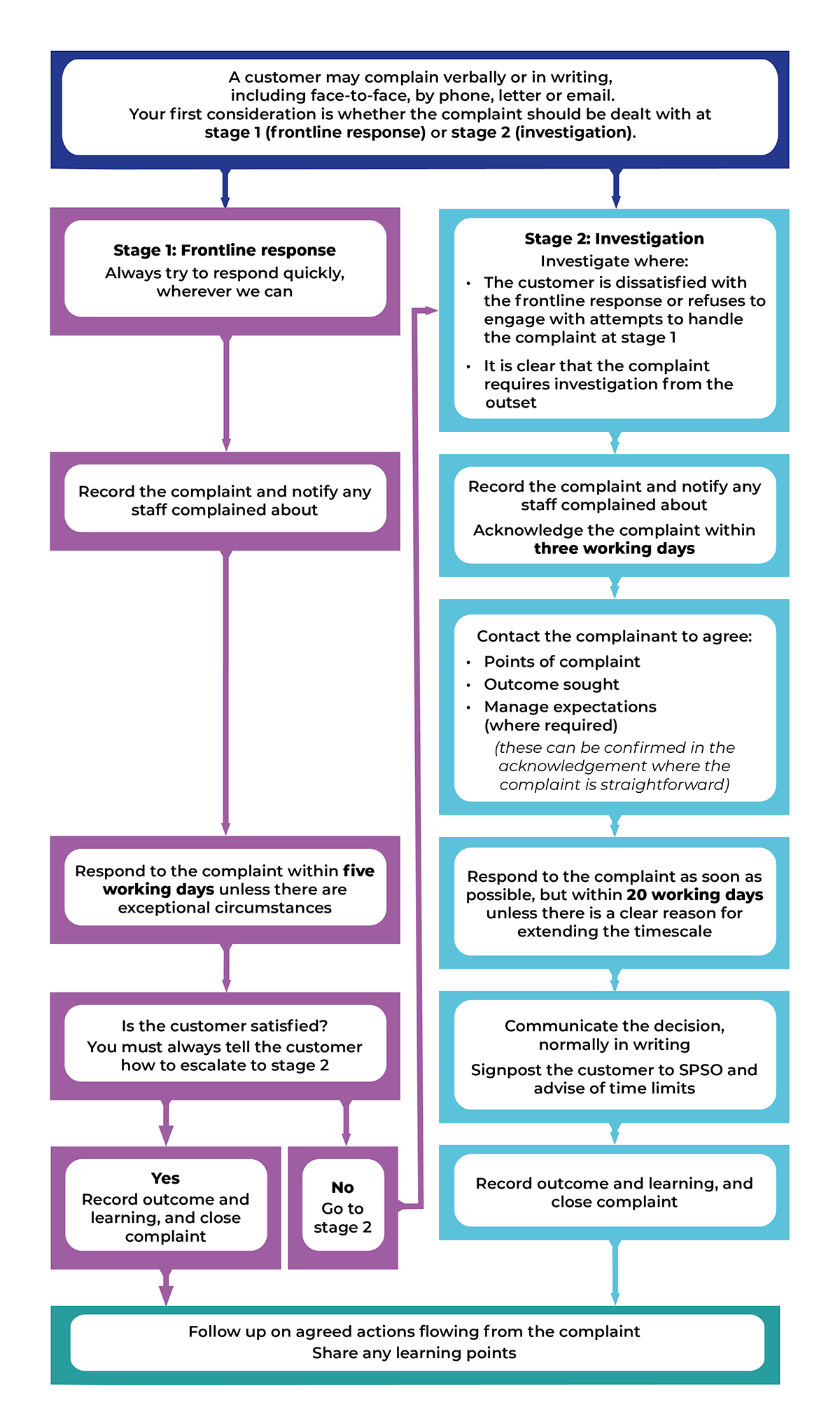
Click to enlarge.
What to do when you receive a complaint
Employees receiving a complaint should consider four key questions. This will help them to either respond to the complaint quickly (at stage 1) or determine whether the complaint is more suitable for stage 2. These four questions should help you to progress and respond to any complaint you receive.
Frequently Asked Questions (FAQs)
We need to be clear about exactly what the customer is complaining about. We may need to ask the customer for more information to get a full understanding.
We need to decide whether the issue can be defined as a complaint and whether there are circumstances that may limit our ability to respond such as the time limit, confidentiality, anonymity or the need for consent. We should also consider whether the complaint is serious, high-risk or high-profile.
If the matter is not suitable for handling as a complaint, we will explain this to the customer and if necessary, signpost them to SPSO.
In most cases, this step will be straightforward. If it is not, the complaint may need to be handled immediately at stage 2
At the outset, we will clarify the outcome the customer wants. Of course, the customer may not be clear about this, and we may need to probe further to find out what they expect, and whether they can be satisfied.
If when handling a complaint you can achieve the expected outcome, for example by providing an on-the-spot apology or explain why you cannot achieve it, you should do so.
The customer may expect more than we can provide. If so, we should tell them this as soon as possible.
Complaints which can be resolved or responded to quickly should be managed at stage 1.
If the complaint is simple and straightforward, but the person receiving the complaint cannot deal with it because, for example, they are unfamiliar with the issues or area of service involved, they should pass the complaint to someone who can respond quickly.
If it is not a simple and straightforward complaint that can realistically be closed within five working days, it should be handled immediately at stage 2. If the customer refuses to engage at stage 1, insisting that they want their complaint investigated, it should be handled immediately at stage 2.
Stage 1 Complaints: Frontline response
Frontline response aims to respond quickly (within five working days) to straightforward complaints that require little or no investigation.
Anyone may deal with complaints at this stage (including an employee being complained about, for example with an explanation or apology). The main principle is to respond to complaints at the earliest opportunity and as close to the point of service delivery as possible.
We may respond to the complaint by providing an on-the-spot apology where appropriate, or explaining why the issue occurred and, where possible, what will be done to stop this happening again. We may also explain that, as an organisation that values complaints, we may use the information given when we review service standards in the future.
Complaints which are not suitable for frontline response should be identified early and handled immediately at stage 2: investigation (see the Stage 2 section below).
Notifying Complaints Team
If the complaint has been received directly by the service from the resident then the service should notify the complaints team to ensure that the complaint is logged and tracked on the CRM system.
Notifying employees involved
If the complaint is about the actions of an employee, the complaint should be shared with them, where possible, before responding (although this should not prevent us responding to the complaint quickly, for example where it is clear that an apology is warranted).
Timelines
Frontline response must be completed within five working days, although in practice we would often expect to respond to the complaint much sooner. ‘Day one’ is always the date of receipt of the complaint (or the next working day if the complaint is received on a weekend or public holiday). If a complaint is received after 4pm on any working day, it will time-stamped for the following day, which will then become day one.
Extension to the timeline
In exceptional circumstances, a short time extension may be necessary due to unforeseen circumstances (such as the availability of a key employee). Extensions must be agreed with an appropriate manager. We will tell the customer about the reasons for the extension, and when they can expect a response. The maximum extension that can be granted is five working days (that is, no more than ten working days in total from the date of receipt at stage 1).
If a complaint will take more than five working days to look into, it should be handled at stage 2 immediately. The only exception to this is where the complaint is simple and could normally be handled within five working days, but it is not possible to begin immediately (for example, due to the absence of a key employee). In such cases, the complaint may still be handled at stage 1 if it is clear that it can be handled within the extended timeframe of up to ten working days.
If a complaint has not been closed within ten working days, it should be escalated to stage 2 for a final response.
Closing the complaint at the frontline response stage
If we convey the decision face-to-face or on the telephone, we are not required to write to the customer as well (although we may choose to). We must:
- Tell the customer the outcome of the complaint (whether it is resolved, upheld, partially upheld or not upheld)
- Explain the reasons for our decision (or the agreed action taken to resolve the complaint
- Explain that the customer can escalate the complaint to stage 2 if they remain dissatisfied and how to do so (we should not signpost to the SPSO until the customer has completed stage 2).
We will keep a full and accurate record of the decision given to the customer. If we are not able to contact the customer by phone, or speak to them in person, we will provide a written response to the complaint where an email or postal address is provided, covering the points above.
A stage one recording form (See Appendix 1) and any correspondence should be forwarded to the complaints team to log on the CRM complaints@eastdunbarton.gov.uk. And the complaint can then be closed.
At the earliest opportunity after the closure of the complaint, the employee handling the complaint should consider whether any learning has been identified.
Stage 1: Issues for consideration
- Should the matter be treated as a complaint?
- Is it more important to treat this complaint directly at stage 2?
- Does the complaints team need to be made aware of the complaint if it has come direct from the service?
- Am I aware of the timescales required to respond and allocated time to investigate and respond accordingly?
- What is the most appropriate means of communication to respond to the customer?
- In providing the stage 1 response have I provided an appropriate outcome and route for escalation to stage 2?
- Following the stage 1 response have I informed the complaints team of the outcome and any improvement/ learning actions taken?
Stage 2 Complaints: Investigation
Not all complaints are suitable for frontline response and not all complaints will be satisfactorily addressed at that stage. Stage 2 is appropriate where:
- The customer is dissatisfied with the Stage 1 response or refuses to engage at the frontline stage, insisting they wish their complaint to be investigated.
- The complaint is not simple and straightforward (for example where the customer has raised a number of issues, or where information from several sources is needed before we can establish what happened and/or what should have happened); or
- The complaint relates to serious, high-risk or high-profile issues
An investigation aims to explore the complaint in more depth and establish all the relevant facts. Further guidance on the Stage 2 Investigation process is available on the SPSO website:
Acknowledging the complaint
Complaints must be acknowledged within three working days of receipt at stage 2.
Where the points of complaint and expected outcomes are clear from the complaint, we must set these out in the acknowledgement and ask the customer to get in touch with us immediately if they disagree.
Where the points of complaint and expected outcomes are not clear, we must tell the customer we will contact them to discuss this.
Agreeing the points of complaint and outcome sought
It is important to be clear from the start of stage 2 about the points of complaint to be investigated and what outcome the customer is seeking. We may also need to manage the customer’s expectations about the scope of our investigation.
Notifying employees involved
If the complaint is about the actions of a particular employee/s, we will notify the employee/s involved (including where the employee is not named but can be identified from the complaint). We will:
- Share the complaint information with the employee/s (unless there are compelling reasons not to)
- Advise them how the complaint will be handled, how they will be kept updated and how we will share the complaint response with them
- Discuss their willingness to engage with alternative complaint resolution approaches (where applicable)
- Signpost the employee/s to a contact person who can provide support and information on what to expect from the complaint process (this must not be the person investigating or signing off the complaint response).
If it is likely that internal disciplinary processes may be involved, the requirements of that process should also be met.
Meeting with the customer during the investigation
To effectively investigate the complaint, it may be necessary to arrange a meeting with the customer.
As a matter of good practice, a written record of any meeting should be completed and provided to the customer.
Timelines
The following deadlines are appropriate to cases at the investigation stage (counting day one as the day of receipt, or the next working day if the complaint was received on a weekend or public holiday):
- Complaints must be acknowledged within three working days
- A draft of the investigation response should be completed and forwarded for the complaints team within 15 working days to allow appropriate time to review the complaint, ensuring consistency of responses and requesting further clarification as required
- A full response to the complaint should be provided as soon as possible but not later than 20 working days from the time the complaint was received for investigation.
If a complaint is received after 4pm on any working day, it will time-stamped for the following day, which will then become day one.
Extension to the timeline
Not all investigations will be able to meet these deadlines. For example, some complaints are so complex that they require careful consideration and detailed investigation beyond the 20 working day timeline. It is important to be realistic and clear with the customer about timeframes, and to advise them early if we think it will not be possible to meet the 20 day timeframe, and why. We should bear in mind that extended delays may have a detrimental effect on the customer.
Any extension must be approved by an appropriate manager. We will keep the customer and any employee/s complained about updated on the reason for the delay and give them a revised timescale for completion. We will contact the customer and any employee/s complained about at least once every 20 working days to update them on the progress of the investigation.
The reasons for an extension might include the following:
- Essential accounts or statements, crucial to establishing the circumstances of the case, are needed from employees, customers or others but the person is not available because of long-term sickness or leave
- We cannot obtain further essential information within normal timescales
- The customer has agreed to alternative complaint resolution approaches as a potential route for resolution.
These are only a few examples, and we will judge the matter in relation to each individual complaint. However, an extension would be the exception.
Closing the complaint at Stage 2
The response to the complaint should be in writing using the corporate template provided in Appendix 2 and must be signed off by a manager or officer who is empowered to provide the final response on behalf of the Council.
We will tell the customer the outcome of the complaint (whether it is resolved, upheld, partially upheld or not upheld). The quality of the complaint response is very important and in terms of good practice should:
- Be clear and easy to understand, written in a way that is person-centred and non-confrontational
- Avoid technical terms, but where these must be used, an explanation of the term should be provided
- Address all the issues raised and demonstrate that each element has been fully and fairly investigated
- Include an apology where things have gone wrong (this is different to an expression of empathy: see the SPSO’s guidance on apology)
- Highlight any area of disagreement and explain why no further action can be taken
- Indicate that a named member of staff is available to clarify any aspect of the letter
- Indicate that if they are not satisfied with the outcome of the local process, they may seek a review by the SPSO (see Signposting to the SPSO).
Where a complaint has been resolved, the response does not need to provide a decision on all points of complaint but should instead confirm the resolution agreed.
If the complaint is about the actions of a particular employee/s, we will share with them any part of the complaint response which relates to them, (unless there are compelling reasons not to).
We will record the decision, and details of how it was communicated to the customer, on the complaints system (CRM).
At the earliest opportunity after the closure of the complaint, the employee handling the complaint should consider whether any learning has been identified.
All stage 2 responses are issued centrally by the complaints team who also have a role in assuring the quality and consistency of responses. As such draft stage 2 responses should be forwarded to the complaints team at least two working days prior to the stage 2 SLA deadline to allow appropriate time for review and feedback to be incorporated if required.
Signposting to the SPSO
Once the investigation stage has been completed, the customer has the right to approach the SPSO if they remain dissatisfied. We must make clear to the customer:
- Their right to ask the SPSO to consider the complaint
- The time limit for doing so
- How to contact the SPSO.
The SPSO considers complaints from people who remain dissatisfied at the conclusion of our complaints procedure. The SPSO looks at issues such as service failure and maladministration (administrative fault), and the way we have handled the complaint.
Post-closure contact
If a customer contacts us for clarification when they have received our final response, we may have further discussion with the customer to clarify our response and answer their questions. However, if the customer is dissatisfied with our response or does not accept our findings, we will explain that we have already given them our final response on the matter and signpost them to the SPSO.
Stage 2: Issues for Consideration
- Has a stage 2 acknowledgement been issued to the customer
- Have the points of complaint been agreed with the customer?
- Does the investigation require a meeting with the customer or members of staff to discuss?
- Will I have any issues meeting the required timescales?
- Is the stage 2 draft response in an appropriate format to be sent to the customer?
- Has the corporate template for the stage 2 complaint been completed?
- Has an appropriate service manager signed off on the draft Stage 2 response?
- Are there any actions to be taken highlighted in the response or lessons to be learned. Have these been recorded?
Child friendly complaints
In line with the United Nations Convention on the Rights of the Child (Incorporation) (Scotland) Act 2024, all public services in Scotland must give children under the age of 18 the chance to have a say about anything that affects them. Read the United Nations Convention on the Rights of the Child (Incorporation) (Scotland) Act 2024. This includes complaints.
The implementation of the Act ensures Children have the right to give their view in complaints about their education, housing or any service they have received from the Council or any other public service.
To help organisations implement their Complaints Handling Procedure in a way that upholds children’s rights under the UNCRC, the Scottish Public Services Ombudsman (SPSO) has developed a set of Child Friendly Complaints Handling Principles and best practice guidance which applies to cases where:
- A child or young person under 18 makes a complaint
An adult makes a complaint on behalf of a child or young person - An adult makes a complaint about something affecting a child or young person.
Read the Child Friendly Complaints Handling Principles.
Read the Child Friendly Complaints Handling Process Guidance.
What does this mean in practice?
- Talking to the Child: We should talk to the child or young person about the complaint and obtain their consent to investigate. We need to check if the child wants to make the complaint themselves or if they would prefer an adult to do it for them
- Involving a Responsible Adult: If the child agrees, a responsible adult (like a parent or carer) may need to be informed and support the child through the process, including sharing the outcome with them
- Professional Judgement: Employees should use their professional judgement to decide on obtaining the child’s consent (based on their age/understanding, capacity, sensitivity of the subject matter), informing a responsible adult and sharing the complaint outcome with the child.
Overall, this approach prioritises children’s well-being, participation, and protection.
Implementation
A checklist for considerations with dealing with child friendly complaints, based on best practice from SPSO and the public sector Complaints Handling Network, can be found in appendix 3.